Shaping the Future of Healthcare Through Global Regulatory Innovation
Global regulatory innovation, led by MHRA in partnership with Singapore’s HSA, is shaping the future of healthcare by accelerating patient access to innovative treatments while preserving safety and trust. Through initiatives such as work-sharing via the Access Consortium, early joint advice, and the Regulatory Innovation Corridor pilot (launched December 2025), regulators are building frameworks that support innovation and faster access. The discussion also covers regulatory questions raised by AI, including agentic AI, and advances in cell, tissue and gene therapies manufacturing, underscoring the need for robust, forward‑looking regulation. Looking ahead, the path forward includes expanding streamlined pathways for clinical trials, health product approvals and health technology assessment, alongside ongoing international partnerships to deliver breakthroughs to patients worldwide through innovative licensing and access pathways.
Emerging technologies like AI and advanced therapies are transforming healthcare, and through international collaboration with partners such as Singapore’s HSA, the MHRA is accelerating patient access to innovative treatments and medicines.
MHRA foreword
At the MHRA, we are seeing how emerging technologies, from artificial intelligence to advanced cell and gene therapies, are transforming healthcare. These innovations offer exciting opportunities to improve patient outcomes, streamline development, and deliver breakthrough treatments more efficiently.
As Adjunct Professor (Dr) Raymond Chua outlines in this blog, collaboration with international partners, including Singapore’s Health Sciences Authority (HSA), is central to making this possible. Through initiatives such as work-sharing, early joint advice, and the newly launched Regulatory Innovation Corridor pilot, the MHRA and HSA are building frameworks that support innovation, accelerate patient access, and maintain the high standards of safety and trust that patients expect worldwide.
Adjunct Professor (Dr) Raymond Chua is the Chief Executive Officer of the Singapore’s HSA. He is also the Deputy Director-General of Health (Health Regulation Group) at the Ministry of Health overseeing the regulations of healthcare services and information.
Guest blog, Professor (Dr) Raymond Chua
Emerging technologies— from Artificial Intelligence (AI) to Cell, Tissue and Gene Therapy Products (CTGTP)— hold immense potential to transform healthcare, improve patient outcomes, and address some of humanity’s most pressing medical challenges.
However, these technologies challenge our existing regulatory frameworks. For instance, agentic AI systems represent a paradigm shift from traditional medical devices. These are autonomous software agents that can analyse patient data, make clinical recommendations, and even adjust treatment protocols independently— like having a digital doctor that learns and adapts. Unlike conventional medical devices with predictable functions, these AI agents can make decisions beyond their original programming. Should we regulate them as products with fixed capabilities, or as evolving services that require ongoing oversight?
Similarly, as personalised treatments increasingly move into point‑of‑care settings, advanced therapy manufacturing is evolving. Unlike current batch-based manufacturing in a single facility, emerging platforms can run multiple cell therapy batches through sterile, closed cartridges across globally-distributed smart factory networks. With traceability via barcode‑tracking and cloud‑based batch documentation, these could also integrate in‑process and release quality control. These technologies signal a future where cell and gene therapy manufacturing becomes high‑throughput, digitally orchestrated and globally scalable.
Realising the potential of these emerging technologies requires more than just scientific ingenuity; it demands regulatory excellence that can foster innovation whilst ensuring safety and trust.
Global Partnerships
No single regulatory agency has all the answers to these novel challenges. That is why we must come together as a global regulatory community. Singapore’s Health Sciences Authority (HSA) is glad to have the partnership of the MHRA in this regard.
I am grateful for the opportunity to sit on the UK’s National Commission on the Regulation of AI in Healthcare at the MHRA’s invitation. Singapore recently updated its AI in Healthcare Guidelines (AIHGle 2.0) to address developments in AI, such as Generative AI, to better support innovation, while ensuring safety and quality. The guidelines articulate good practices for AI developers, healthcare organisations and healthcare professionals using these solutions. I look forward to exchanging ideas on how regulators can better support innovation in this space.
Regulatory collaboration translates to real benefits for companies and patients. Through the Access Consortium, we work with the UK, Australia, Canada and Switzerland. Almost 40 new active substances have been approved through the Access work-sharing initiative and benefitted from faster median rollout times.[1] Beyond work-sharing, we are also piloting new initiatives with the MHRA. Launched in December 2025, the Regulatory Innovation Corridor will give regulators early insight into emerging products, ensuring that regulatory frameworks remain fit for purpose. It will also offer companies a route to engage both regulators simultaneously for early, informal joint advice — supporting stronger forward planning and more robust clinical trial design. Ultimately, the aim is to accelerate patient access to breakthrough innovations, like advanced diagnostics and therapies for cancer, neurodegenerative diseases, obesity, and rare conditions.
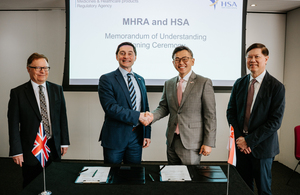
Last week HSA and MHRA signed a refreshed Memorandum of Understanding. This reaffirms our commitment to work more closely in building a global regulatory environment that will accelerate access to innovative treatments for patients around the world.
We welcome continued partnership with other regulators to exchange ideas on innovative regulatory approaches, drive regulatory convergence and enhance regulatory reliance.
The Path Forward
We believe that robust regulation enables sustainable innovation and can be a significant contributor to growth for the biomedical sector. To this end, with Singapore attaining WHO’s highest Maturity Level 4 for its advanced regulatory system for marketing authorisation of medicines, vaccines (non-producing country), and medical devices as well as WHO-Listed Authority status for medicines, HSA is expanding its mandate beyond regulations to support industry development, providing a more holistic value proposition to companies. HSA will be working closely with other partners to enhance the vibrancy of Singapore’s biomedical ecosystem. In addition to strengthening coordination across the end-to-end value chain, we are also exploring tailored pathways that could streamline clinical trial applications, health product regulatory approvals and health technology assessment. We note that MHRA and NICE have rolled out the Innovative Licensing and Access Pathway for medicines and the Innovative Devices Access Pathway for medical devices to bring access of these products to patients in the UK health system more quickly and we definitely appreciate MHRA’s support and guidance as well.
With continued international partnerships and regulatory transformation, we can create regulatory ecosystems that are both rigorous and responsive to rapidly evolving healthcare needs. Singapore remains committed and looks forward to working with regulatory partners like the UK to build this future together, ensuring that emerging technologies translate into real benefits for patients worldwide.
[1] CIRs article that compared regulatory timelines found that NAS that were approved through the ACCESS NAS work-sharing initiative benefitted from faster median rollout times. Extracted from: https://cirsci.org/wp-content/uploads/dlm_uploads/2025/03/CIRS-RD-Briefing-97-Access-and-Orbis-v1.1.pdf