Protecting children's right to safe, inclusive, quality education is critical: UK statement at the UN Security Council
UK's statement to the UN Security Council emphasizes that protecting children’s right to safe, inclusive, quality education in conflict is critical, citing the damage to schools and millions of out-of-school children in Gaza, Sudan, and Ukraine and urging protection of civilians and adherence to international humanitarian law. It backs the Safe Schools Declaration and highlights UK support for UNICEF and the Global Partnership for Education. The speech also notes that emerging technologies can help sustain learning through digital tools, remote platforms, and AI-supported systems, while warning of risks such as online recruitment of children by armed groups and urging accountability for violations. Finally, it stresses that conflict disproportionately harms girls’ education, supports girls’ education in crises (over 7 million via Education Cannot Wait), and calls on the private sector to ensure technology meets girls’ needs.
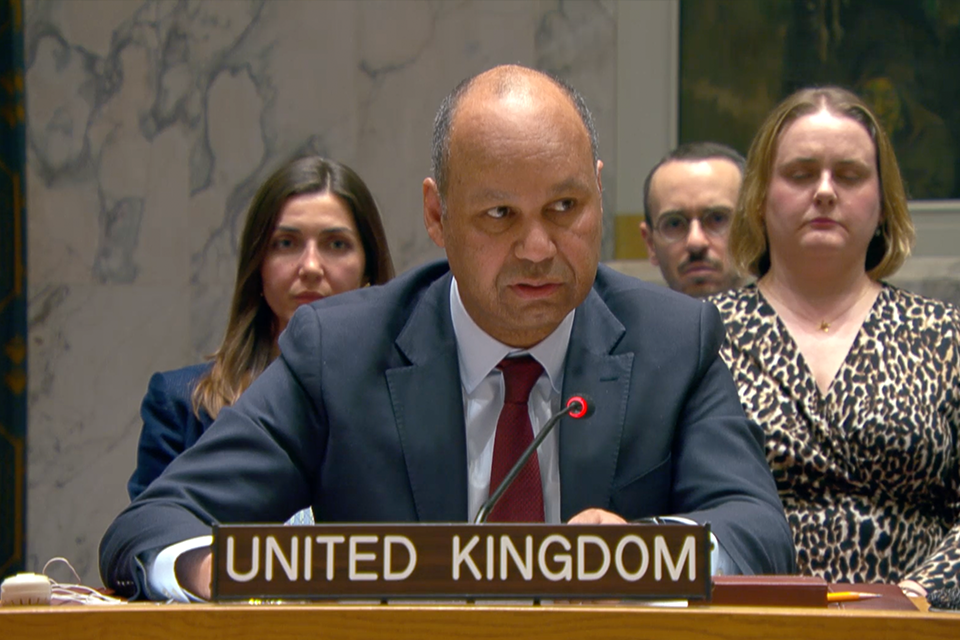
Statement by Ambassador James Kariuki, UK Chargé d’Affaires to the UN, at the UN Security Council meeting on Children, Technology and Education in Conflict.
Let me begin by welcoming you, First Lady, to the Security Council and thanking you for your leadership on this important issue.
I also congratulate the United States on assuming the Presidency of the Council for the month of March. You have our full support.
And I thank Under Secretary-General DiCarlo for briefing us today.
I will make three points.
First, protecting children’s right to safe, inclusive, quality education is critical. And yet, around the world, education systems are collapsing in conditions of conflict.
In Gaza, 97% of schools have been damaged or destroyed, and over 650,000 children have been out of school for over two years.
In Sudan, one in three schools has been damaged or destroyed, and 8 million children are out of school.
In Ukraine, 4.6 million children face barriers to learning as a result of Russia’s illegal and unprovoked full-scale invasion.
The current conflict in the Middle East poses further risks.
Children and civilian infrastructure, including schools, need to be protected.
Parties to conflict must adhere to their obligations under international humanitarian law.
The United Kingdom supports the implementation of the Safe Schools Declaration and urges other member states to commit to it.
We are also proud to support global efforts to safeguard children’s education in crises, including through our support for UNICEF and the Global Partnership for Education.
Second, emerging technologies can play a transformative role in sustaining learning for children impacted by conflict and displacement.
While not a substitute for in-person schooling, digital tools, remote learning platforms, and AI-supported systems can help children keep learning when classrooms are destroyed or inaccessible, and to access psychosocial support.
But we also need to manage the risks of technology for children in conflict.
For example, in Colombia, armed groups are increasingly using online platforms to recruit children.
The United Kingdom is committed to ensuring accountability for grave violations against children in conflict, including through our support for the UN Monitoring and Reporting Mechanism.
Technology companies and governments also have a key role to play in strengthening safeguards against such risks.
Third, Madame President, conflict disproportionately impacts girls’ education.
Girls are more likely to be out of school than boys in conflict settings.
And as a result, they face heightened risks, including risks of exploitation, child marriage, trafficking, and sexual and gender-based violence.
The United Kingdom is proud to support girls’ education in crises, including over 7 million supported through the Education Cannot Wait fund.
And we call on the private sector, working with governments and civil society, to ensure technology meets the particular needs of girls whose education is impacted by conflict.