Barriers to work removed for disabled benefit claimants as landmark legislation introduced
The new landmark legislation removes the fear of immediate benefits loss for disabled people who want to try work by ensuring entering employment will not automatically trigger reassessment for claimants on new-style Employment and Support Allowance, Personal Independence Payment, and the health element of Universal Credit. It also guarantees that those looking to volunteer can do so without fear of benefit reassessment, following recommendations from disabled people during extensive stakeholder engagement via the Collaboration Committees. The changes are part of a wider welfare reform to incentivise and support sick or disabled people into jobs, backed by £3.5 billion in tailored employment support by the end of the decade. The reforms also tackle perverse incentives in the Universal Credit system by introducing a lower health element for new claimants, saving nearly £1 billion, and are complemented by programmes such as WorkWell and the Connect to Work, aimed at helping 2.8 million people out of work due to long-term sickness.
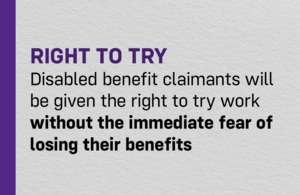
Disabled benefit claimants will be given the right to try work without the immediate fear of losing their benefits, with new legislation laid today (Thursday 9th April).
- New legislation removes fear of immediate benefits loss for disabled people who want to try work
- Policy changes developed by disabled people and those with health conditions via ‘Collaboration Committee’
- Comes as part of wider welfare reform to incentivise and support sick and disabled people into jobs- backed by £3.5 billion in employment help by end of decade
The current system inherited by this Government is leaving people stranded on the benefits system, afraid of trying work. More than a third (37 percent) of disabled people and people with health conditions in the DWP work aspirations survey said they want to work but are held back by fear of losing their benefits.
The landmark legislation – coming into force at the end of April – means entering employment will not automatically trigger benefit reassessment for claimants on new-style Employment and Support Allowance, Personal Independence Payment, and Universal Credit health element.
Following recommendations made by disabled people and their representative organisations during extensive stakeholder engagement, the legislation also includes a guarantee that those looking to volunteer will be able to do so without fear of benefit reassessment – helping people move closer to, or into, work.
The changes are part of the Government’s drive to unlock work for sick or disabled people and boost living standards, by helping them move into good, secure jobs. This is backed by a £3.5 billion investment in tailored employment support by the end of the decade.
Minister for Social Security and Disability, Sir Stephen Timms, said:
Giving sick and disabled people legal protection to try work without fear is vital for their futures and for growing our economy.
It’s part of the work we’re doing to bear down on the cost of living and boost living standards for sick or disabled people in every corner of the country.
With 2.8 million people out of work due to long-term sickness, we’re removing the barriers that have held people back for too long.
Whilst this legislation ensures that entering work is not in itself a trigger for reassessment, where a reassessment is already due to take place, this will continue as normal.
Brian Dow, Chief Executive, Mental Health UK, said:
People often tell us that fear of reassessment, or even losing essential support if things don’t work out, is a significant barrier to taking those first steps back into work. The Right to Try is a positive and practical step that will ensure people have a safety net when exploring opportunities for work or volunteering.
This welcome initiative will ensure people are more supported and help them to build confidence, skills and connection at a pace that supports their recovery to better mental health.
Minesh Patel, Associate Director of Evidence, Advocacy and Performance at Mind, said:
Many people with mental health problems want to work but often worry about losing financial support from the benefits system if they try to do so.
These reforms are a step in the right direction to help disabled people build up their confidence and skills to move into sustained and meaningful employment where this is an option. It’s positive to see the inclusion of volunteering as part of these changes. Volunteering can provide individuals with more flexibility and options and can often be a gateway to employment, whilst also being beneficial for people’s mental health.
The Government’s wider support offer includes innovative programmes that meet sick or disabled people where they are, such as WorkWell - which is now set to unlock opportunities for 250,000 more people - and the Connect to Work programme which will provide personalised help for 300,000 people over the next five years.
Reforms which have just come into force will also tackle the perverse incentives in the Universal Credit system inherited by this government, which keep people trapped on benefits. By introducing a lower health element for new claimants, the government will save nearly £1 billion in taxpayer money and help move people towards work.
Our DWP-led Collaboration Committees were fundamental in bringing together the voices of disabled people, and the organisations representing them, for honest and open discussion on this legislation. Our inclusion of volunteering in this legislation came as a direct result of this consultation, ensuring we are listening to disabled people on how work opportunities can be unlocked for them.
Jon Sparkes OBE, Chief Executive of learning disability charity Mencap:
These are sensible and welcome steps to support more disabled people into work and help rebuild trust in a system that has caused real anxiety for many in the past.
People with a learning disability want to work, but the benefits system is often the biggest barrier, so protecting people’s benefits when they try work is particularly important.
We also welcome the upfront investment in employment support and the commitment to work more closely with disabled people themselves. The more people with lived experience are part of shaping the solutions – including through the Collaboration Committee – the more likely these changes are to succeed.
Additional information:
- Online guidance will be updated on Gov.UK in the coming days.
- The DWP work aspirations survey is available online: Work aspirations and support needs of health and disability customers: Final findings report - GOV.UK