AI-trained robotic mice to scurry in the Large Hadron Collider
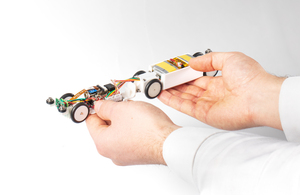
UKAEA and CERN have developed PipeINEER, a mouse-sized autonomous robot designed to inspect the Large Hadron Collider. The 20 cm long device can travel through beamline spaces as narrow as 3.7 by 3.7 cm and can cover up to six kilometres on a single battery charge, using AI trained on real LHC imagery to detect abnormalities in Plug‑In Modules (PIMs). If it detects an issue, PipeINEER returns to its starting point and reports the precise location for targeted interventions without disassembling large sections of pipe. The project is still in development, with 60 km of operation testing planned for late 2026, final units to be manufactured in late 2026, and CERN operators to be trained in early 2027; it was named “Highly Commended” in The Engineer’s Collaborate to Innovate Award, underscoring international collaboration.
Mouse-sized robot developed by UKAEA and CERN to inspect Large Hadron Collider, highlighting the power of international collaboration.
Mouse-sized robot inspired by fusion energy and developed by UKAEA and CERN to inspect the Large Hadron Collider (LHC) is ‘Highly Commended’ at prestigious Collaborate to Innovate Awards.
The UK Atomic Energy Authority (UKAEA) and CERN – the European Laboratory for Particle Physics – have been awarded as ‘Highly Commended’ for The Engineer’s ‘Collaborate to Innovate (C2I) Award’ for their joint development of a small autonomous robot created to inspect the Large Hadron Collider (LHC), the world’s most powerful particle accelerator.
Named ‘PipeINEER’ (a portmanteau of Pipe and Pioneer), this first-of-its-kind, 3.7cm-wide robot was designed to travel autonomously through long, narrow pipes called the beamline, along the 27-kilometre-long LHC.
At the heart of the LHC, the beamlines are surrounded by superconducting magnets kept at the very low temperature of -271°C. The beamlines operate under ultra-high-vacuum conditions, and their position deep within the infrastructure that supports these extremes makes human access and inspection extremely challenging.
To meet these challenges, CERN partnered with UKAEA’s robotics centre RACE (Remote Applications in Challenging Environments), with remote handling expertise in hazardous and hard-to-reach environments, to develop a robotic solution.
Nick Sykes, Director of RACE, UKAEA, said:
This award highlights the power of international collaboration, bringing together UKAEA and CERN alongside the wider global scientific community.
We’re proud to apply our robotics expertise from fusion energy to support CERN’s world leading experiments. By combining our remote handling experience with CERN’s scientific excellence, we’re helping ensure the Large Hadron Collider operates safely and efficiently for years to come.
Dr Giuseppe Bregliozzi, Beam Vacuum Operation Section Leader, CERN, said:
PipeINEER will transform how we inspect and maintain the LHC. It marks a major step forward in keeping our experiments running smoothly.
Big challenge, small solution
CERN, located near Geneva on the French–Swiss border, operates the 27-kilometre-long LHC underground tunnel, where subatomic particles are accelerated to nearly the speed of light to help scientists understand the fundamental nature of the universe. The LHC has been central to major scientific discoveries, including the identification of the Higgs boson.
Inside the LHC, particles travel through the long, narrow beamline, under ultra-high-vacuum at the extremely low temperatures of –271°C. To handle the expansion and contraction caused by these harsh conditions, the LHC contains around 2,000 Plug‑In Modules (PIMs). Over time, small components within these modules—especially thin Radio Frequency (RF) fingers that maintain electrical contact—can bend slightly due to thermal cycling. Even tiny deformations can create obstructions inside the beamline, disrupting experiments and causing costly delays.
RACE is known for its expertise in designing robots for hazardous and hard-to-reach places, including fusion energy, nuclear facilities and space structures.
Together, the teams developed PipeINEER, a first-of-its-kind, 20‑centimetre-long robot designed to travel autonomously through spaces as narrow as 3.7 by 3.7 centimetres inside the beamline. Unlike existing pipe inspection systems, PipeINEER can navigate up to six kilometres on battery power alone on a single mission – roughly the length of 60 football pitches placed end‑to‑end – while operating in a space only a few centimetres wide. As the robot moves, it captures detailed images of each PIM and uses artificial intelligence trained on real LHC imagery to detect any abnormalities. It is equipped with energy‑efficient systems and multiple safety features that monitor its performance during long autonomous runs.
If the robot detects an issue, it returns to its starting point and reports the exact location of the problem. This targeted approach allows engineers to address specific points along the 27-kilometre collider, without disassembling large sections of pipe and using a manual endoscope – a process that is extremely time-consuming and expensive.
The highly commended PipeINEER robots are in the development stage, with robot performance being tested over 60km of operation later in 2026. Following this testing, final units will be manufactured in late-2026 and CERN operators trained on the new units in early 2027.
The ‘Collaborate to Innovate’ Award was presented in London on 26th February 2026.
The PipeINEER robotic ‘mice’ - a UKAEA-CERN project
Robotic mice to scurry in Large Hadron Collider │ The UKAEA-CERN PipeINEER
https://www.gov.uk/government/news/ai-trained-robotic-mice-to-scurry-in-the-large-hadron-collider