Health service to save millions with boost to electrify NHS fleet
An extension of the NHS Chargepoint Accelerator Scheme provides a £4 million boost to NHS charging infrastructure, bringing total government funding to £22 million to electrify the UK’s second-largest fleet and decarbonise 460 million miles of travel each year. The investment will roll out hundreds of new EV charging sockets for NHS vehicles, helping to save millions in fuel and maintenance costs that can be reinvested into frontline care. With public EV chargers now numbering 116,052 nationwide, the initiative supports faster electrification, cleaner hospital surroundings, and ongoing NHS productivity gains.
Switching the NHS vehicle fleet to electric will save the health sector millions and help reduce 460 million miles worth of journeys across England.
- £4 million boost to NHS chargepoint scheme to help modernise the health service and save millions in fuel costs
- brings combined investment from the Department for Transport and Department for Health to £22 million to electrify the UK’s second largest fleet and clean up 460 million journey miles a year
- comes as new figures show public EV chargers have now reached a record 116,052 as the UK’s charging network continues to expand
The NHS in England is receiving a £4 million boost to roll out hundreds of new electric vehicle (EV) charging sockets, thanks to an extension to the Department for Transport’s NHS Chargepoint Accelerator Scheme announced today (27 February 2026).
The extension builds on government funding supporting the delivery of over 1,000 EV charging sockets to power up electric ambulances and fleets, saving millions on maintenance and fuel costs, which can be invested directly back into frontline care.
This announcement brings total government investment in NHS charging infrastructure to £22 million, following the Department for Health and Social Care awarding NHS trusts £10 million last month and £8 million awarded from DfT last year.
This funding will support the NHS to modernise some of its 20,000 strong fleet of medical vehicles, helping to decarbonise 460 million miles of travel each year.
The savings will be reinvested to deliver on the government’s goal of a more efficient, modern healthcare system, building on progress made to date. This includes the delivery of 5 million extra appointments in the last year and bringing waiting lists down by 330,000 since July 2024 – their lowest level in 3 years.
Aviation, Maritime and Decarbonisation Minister, Keir Mather, said:
Backing the switch to electric for our NHS fleet will save our health sector millions and help to clean up 460 million miles worth of journeys across England – that’s good for taxpayers, patients and our communities.
With over 116,000 public chargers now on UK roads, our investment is transforming the UK’s public charging network so more drivers can make the switch to electric with confidence.
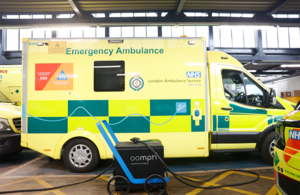
To see first-hand how funding for EV charging infrastructure has helped transform NHS services, EV Minister Keir Mather visited the London Ambulance Service HQ in Waterloo yesterday to see how investment from the government supported installation of chargers across the fleet.
The government is providing record funding to rebuild the NHS and make it fit for the future. By eliminating wasteful spending and embracing technology, the health service is overperforming on its ambitious goal of 2% annual productivity growth. Latest NHS data shows NHS productivity has grown by 2.8% between April and October 2025 compared to the year before.
Investing in environmental initiatives such as electrifying the NHS fleet helps ensure value for taxpayers by unlocking valuable savings for the health service for years to come.
Minister of State for Health, Karin Smyth, said:
With cleaner vehicles and lower fuel bills for the NHS, everybody wins. Savings made from this investment will be redirected back to where they’re needed – getting patients seen on time again.
With taxpayers getting more bang for their buck and more money for patient care, there is not just a moral case for this investment, but a pragmatic one, too.
This funding is clear proof we’re upgrading and modernising the NHS and making it fit for the next century and beyond.
Chris Gormley, Chief Sustainability Officer at NHS England, said:
Moving to electric vehicles is helping to make the NHS fit for the future – providing quick response times for patients and improving air quality around hospitals.
Thanks to this new funding and continued investment from the government, more NHS trusts will also save on fuel and maintenance costs. Zero emission vehicles are expected to save the NHS tens of millions every year, which can then be reinvested directly into frontline care for patients.
New public charging figures released by DfT this week show there are now 116,052 public EV chargers in place across the UK.
This new updated data provides a more accurate picture of the UK’s charging capacity by reporting individual EV chargers, which typically serve one vehicle, rather than charging devices that may contain several chargers. It offers the strongest estimate yet of how many vehicles can be charged at any one time. Based on estimates of industry data, these new figures suggest there are now considerably more EV chargers than fuel pumps across the UK.
The government is providing more funding than ever to roll out EV charging, with an additional £600 million announced last year on top of £400 million for local councils to deliver 100,000 charge points.
Jade Edwards, Head of Insights, Zapmap, said:
As the EV charging infrastructure develops in the UK and we move towards more widespread adoption of EVs, changes to the way we report on growth, alongside a move towards more standardised terminology, help ensure that new and prospective EV drivers have a clear understanding of the charging options available to them.
Ian McKee, Head of Communications, ChargeUK:
Our sector has been charging ahead with the rollout of infrastructure to support the growing number of EV drivers on UK roads. The total number of charging devices is one way to track how we’re doing and consistently shows the direction of travel, but it doesn’t show the whole picture of progress towards putting the right chargers in the right places.
The introduction of a new metric, EV chargers, into the government’s official figures is a welcome move that, alongside the data on types and locations, will help to provide greater transparency to inform the EV transition.
Today’s announcement follows the announcement this week that renters, landlords, and businesses will be able to claim back almost half the cost of installing an EV charger, saving up to £500. The extension of the Home and Workplace Grant scheme will slash installation costs for drivers and unlock home charging for as little as 2p per mile – helping make EV ownership a reality for more drivers and putting more money in people’s pockets.
The government is also backing drivers to go electric by reducing upfront costs through the Electric Car Grant , which offers discounts of up to £3,750 off dozens of EVs, and has supported over 65,000 drivers go electric.
See the list of vehicles eligible for the Electric Car Grant.
Last month, DFT launched its new ‘Get that electric feeling’ campaign to help drive uptake in EVs by highlighting the benefits of going electric, including savings of up to £1,400 on running costs.
https://www.gov.uk/government/news/health-service-to-save-millions-with-boost-to-electrify-nhs-fleet