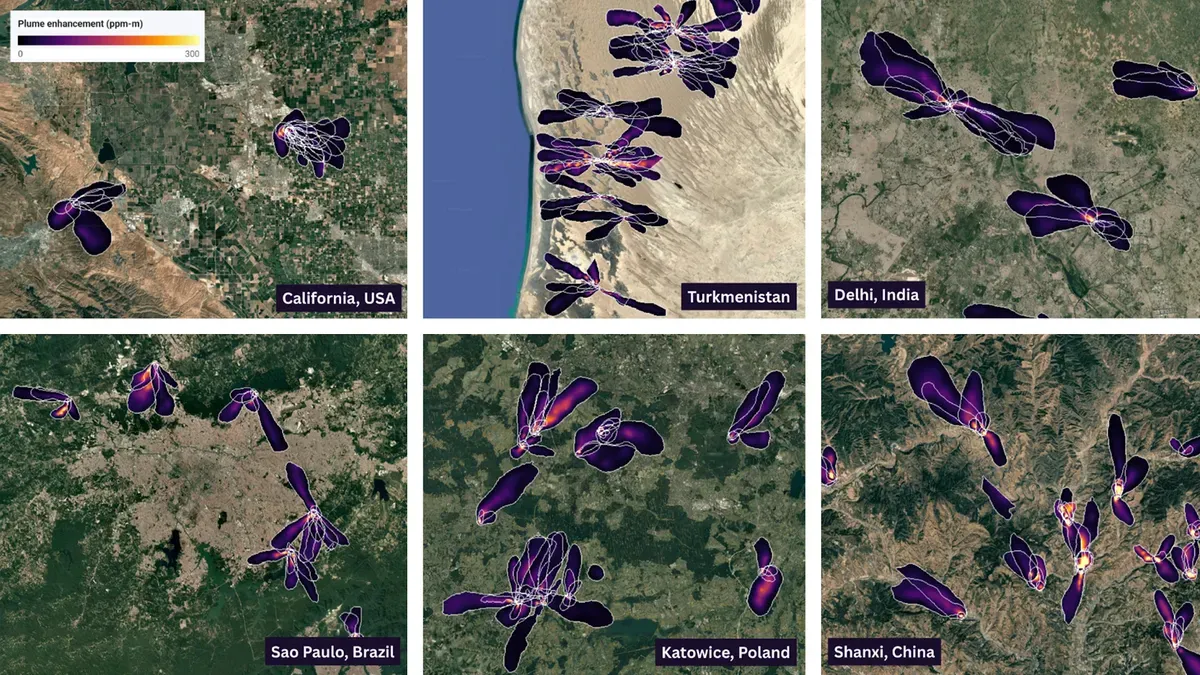
A new deep learning model maps global methane emissions from space.
In a new study published in PNAS, Google and NASA’s Jet Propulsion Laboratory (JPL) introduced MAPL-EMIT, an AI model that tracks methane emissions globally from space using NASA’s EMIT instrument.
Methane is a potent greenhouse gas. Over a 100-year timeframe, its warming potential is 30 times greater than that of carbon dioxide. MAPL-EMIT tackles a critical bottleneck in methane detection. Trained on 3.6 million physics-simulated methane plumes (clouds of methane gas released into the atmosphere), it cuts through complex, noisy terrain to detect 50% more plumes than human experts and identifies more than 23,000 additional plumes globally, including 24 out of 25 of the world’s largest-emitting landfills. By making methane sources easier to find at scale, MAPL-EMIT enables faster, more targeted climate mitigation.
Google has released the global plume database on Earth Engine alongside an Earth Engine app to visualize the data. Open-source models are available on Kaggle and inference tools are on GitHub to support researchers, policymakers, and operators. Read more on the Google Research blog.
Google Italia
Ukázka dat Dun & Bradstreet
| Název společnosti | AUDI Aktiengesellschaft |
|---|---|
| D-U-N-S číslo | 315731679 |
| Registrační číslo / Popis | HRB1 Register Number (DE) |
| Registrační číslo / Popis | 85049B1 Derived Unique Register Number (DE) |
| Registrační číslo / Popis | DE811115368 Value Added Tax Number (DE) |
| Telefon | +49 841890 |
| Typ subjektu | Corporation |
| Právní forma | Deemed Public Limited Company |
| Roční obrat | 64 500 000 000 EUR / 71 157 238 500 USD - 01.01.2024 |
| Počet zaměstnanců | 86 900 - 01.01.2024 |
| Stav | Active |
| Adresa | Auto-Union-Str. 1, Ingolstadt, 85057, Germany |
| Webová stránka | www.audi.com |
| [email protected] | |
| Předmět podnikání | Mfg motor vehicle/car bodies |
| Typ vlastnictví | Privately owned |
| Datum založení | 16.04.1884 |
| Statutární zástupci | Gernot Döllner |
| Vlastníci | Bundesland Niedersachsen, Streubesitz, GOVERNMENT OF QATAR, Ferdinand Porsche Familien-Privatstiftung, Kai Alexander Porsche, Peter Daniell Porsche, Ferdinand Oliver Porsche, Geraldine Porsche, Mark Philipp Porsche, Hubertus Josef Kiesling, Diana Porsche, Andreas Kiesling, Peter Daniell Porsche, Kai Alexander Porsche, Ferdinand Oliver Porsche, Mark Philipp Porsche, Geraldine Porsche, Diana Porsche, Hubertus Josef Kiesling, Andreas Kiesling, Wolfgang Porsche, Stephanie Porsche- Schröder, Felix Alexander Porsche, Christian Porsche, Ferdinand Rudolf Wolfgang Porsche |