A surprising twist in the quantum world
V článku se popisuje první přímé pozorování optického Magnusova jevu u atomu, konkrétně u jednoho iontu kalcia, které je umístěno v iontovém pasti. Pokus ukázal, že maximum interakce s laserovým paprskem se posouvá na stranu – ozvěta klasického Magnusova jevu, jenž má důsledky pro přesnou kontrolu qubitů v kvantových počítačích. Experiment také odhalil, že velikost posuvu závisí jen na vlnové délce světla, nikoli na stupni zaostření paprsku, a může nabídnout nové způsoby pro vzájemné provázání qubitů.
Researchers at the Paul Scherrer Institute PSI, ETH Zurich and the University of Amsterdam have directly observed the optical Magnus effect for the first time. This phenomenon is the optical counterpart of an effect from classical mechanics. It is relevant to quantum computing because it can influence the precise control of qubits, the fundamental units of quantum information.
Table tennis professionals are true masters at redirecting fast-moving projectiles. Putting a targeted spin on a serve can make the little white ball fly straight towards the edge of the table but then, at the last moment, take a sharp curve into the left corner. The physical phenomenon behind this sporting trick is known as the Magnus effect. It acts on balls of all sizes and has helped decide more than a few football matches.
An international research collaboration at the Paul Scherrer Institute PSI has now taken the leap from ball to atom, experimentally demonstrating the so-called optical Magnus effect for the first time. In this case, however, there is no atom flying along a curved trajectory. Instead, the researchers direct a tightly focused laser beam at a single ion and observe the resulting interaction.
With this they were able to show that the point of maximum interaction is shifted sideways – an important finding for the development of quantum computers in which laser light is used to precisely control qubits. The researchers report their findings in the journal Physical Review Letters.
When the centre is suddenly off-centre
With a tightly focused laser beam directed at an ion, one would expect the strongest interaction to occur where the laser beam is most intense: at its centre. However, tightly focusing the laser also changes the spatial structure of its electromagnetic field. As a result, the interaction with the ion is strongest not exactly at the centre of the laser beam, but slightly to one side. This sideways shift is the optical counterpart of the Magnus effect seen in the flight of a table tennis ball.
And just as an unexpected deviation in sports can mean losing the ball, in quantum computers it can mean the loss of control. There laser light is used to selectively change the state of qubits. The optical Magnus effect could interfere with this precise control and contribute to errors if it is not taken into account.
At the same time, the effect also presents an opportunity: “The forces it generates could be used to couple qubits to one another, enabling more complex computations,” explains first author Philip Leindecker from the PSI Center for Photon Science and the Department of Physics at ETH Zurich.
A map of laser light
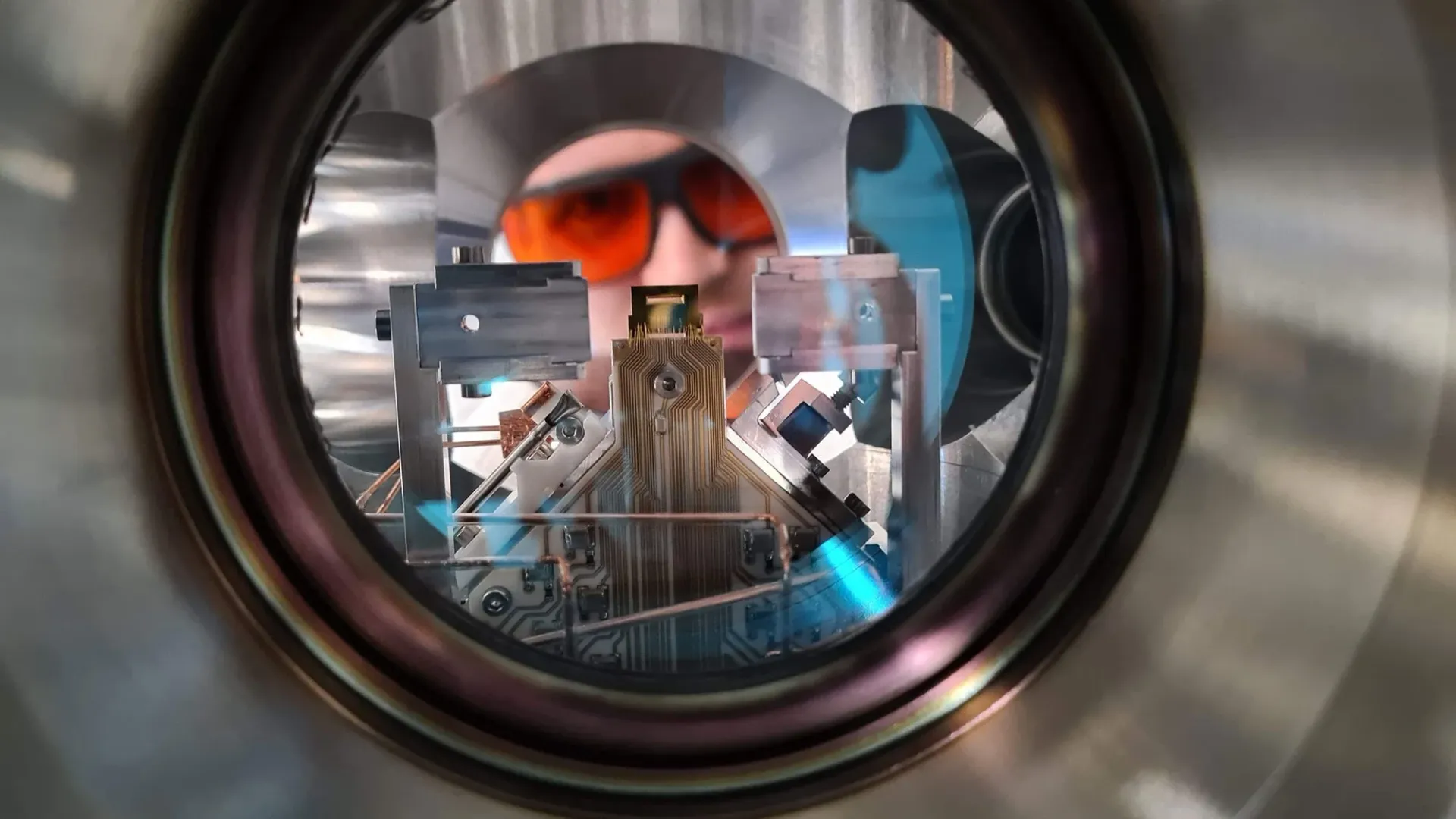
To make the optical Magnus effect visible, the researchers used a single calcium ion as a tiny and extremely sensitive probe. The electrically charged atom is held almost motionless at a fixed position in a so-called ion trap using electromagnetic fields. Such trapped ions are also used in quantum computers, where they can serve as qubits whose quantum states can be precisely manipulated using laser light.
For their experiment, the researchers investigated how strongly the calcium ion interacts with the light from a tightly focused laser at different positions. “Our ion acts like a tiny sensor that we can use to feel out the structure of the laser light,” Leindecker explains. “This makes it possible to measure a shift of just a few hundred nanometres.” The experiment also revealed a surprising characteristic of the effect: the magnitude of the shift depends solely on the wavelength of the light, not on how tightly the laser is focused.
Researchers at the University of Amsterdam had theoretically predicted the optical Magnus effect several years earlier. Now, using the trapped calcium ion, the team has succeeded in observing the effect for the first time and characterising it more precisely.
Philip Leindecker
ETH Zurich - PSI Quantum Computing Hub
PSI Center for Photon Science
Paul Scherrer Institute PSI
+41 56 310 48 71
[email protected]
[German, English]
Direct Observation of the Optical Magnus Effect with a Trapped Ion
Philip Leindecker et al.
Physical Review Letters, 06.08.2026 (online)
DOI: 10.1103/kj5p-qqs5
About PSI
The Paul Scherrer Institute PSI develops, builds and operates large, complex research facilities and makes them available to the national and international research community. The institute's own key research priorities are in the fields of future technologies, energy and climate, health innovation and fundamentals of nature. PSI is committed to the training of future generations. Therefore about one quarter of our staff are post-docs, post-graduates or apprentices. Altogether PSI employs 2300 people, thus being the largest research institute in Switzerland. The annual budget amounts to approximately CHF 450 million. PSI is part of the ETH Domain, with the other members being the two Swiss Federal Institutes of Technology, ETH Zurich and EPFL Lausanne, as well as Eawag (Swiss Federal Institute of Aquatic Science and Technology), Empa (Swiss Federal Laboratories for Materials Science and Technology) and WSL (Swiss Federal Institute for Forest, Snow and Landscape Research). (Last updated in June 2026)
https://www.psi.ch/en/news/media-releases/a-surprising-twist-in-the-quantum-world
Philip Leindecker
[email protected]
+41 563104871
Společnost / Organizace
Paul Scherrer Institut (PSI)

Ukázka dat Dun & Bradstreet
| Název společnosti | AUDI Aktiengesellschaft |
|---|---|
| D-U-N-S číslo | 315731679 |
| Registrační číslo / Popis | HRB1 Register Number (DE) |
| Registrační číslo / Popis | 85049B1 Derived Unique Register Number (DE) |
| Registrační číslo / Popis | DE811115368 Value Added Tax Number (DE) |
| Telefon | +49 841890 |
| Typ subjektu | Corporation |
| Právní forma | Deemed Public Limited Company |
| Roční obrat | 64 500 000 000 EUR / 71 157 238 500 USD - 01.01.2024 |
| Počet zaměstnanců | 86 900 - 01.01.2024 |
| Stav | Active |
| Adresa | Auto-Union-Str. 1, Ingolstadt, 85057, Germany |
| Webová stránka | www.audi.com |
| [email protected] | |
| Předmět podnikání | Mfg motor vehicle/car bodies |
| Typ vlastnictví | Privately owned |
| Datum založení | 16.04.1884 |
| Statutární zástupci | Gernot Döllner |
| Vlastníci | Bundesland Niedersachsen, Streubesitz, GOVERNMENT OF QATAR, Ferdinand Porsche Familien-Privatstiftung, Kai Alexander Porsche, Peter Daniell Porsche, Ferdinand Oliver Porsche, Geraldine Porsche, Mark Philipp Porsche, Hubertus Josef Kiesling, Diana Porsche, Andreas Kiesling, Peter Daniell Porsche, Kai Alexander Porsche, Ferdinand Oliver Porsche, Mark Philipp Porsche, Geraldine Porsche, Diana Porsche, Hubertus Josef Kiesling, Andreas Kiesling, Wolfgang Porsche, Stephanie Porsche- Schröder, Felix Alexander Porsche, Christian Porsche, Ferdinand Rudolf Wolfgang Porsche |