UK-Portugal partnership boosts use of robotics in marine research
The UK’s National Oceanography Centre (NOC) and Portugal’s ARDITI, with support from the British Embassy Lisbon, have agreed a partnership to strengthen marine research around Madeira by transferring two UK-designed Autosub Long Range autonomous underwater vehicles. Valued at €4.3 million, the ALRs will support deep‑water research: one rated to 1,500 metres for oceanographic and biogeochemical studies and the other to 6,000 metres for deep‑sea mapping, and will be integrated into ARDITI’s programmes via the Ocean Observatory of Madeira. The collaboration, highlighted by a 24 October event aboard the Royal Research Ship Discovery and shaping plans for a 2026 Ocean Monitoring Workshop, represents a new model for UK public‑research partnerships, expands UK technology reach, and includes safeguards restricting onward collaboration with states deemed to pose security risks.
The National Oceanography Centre and Portugal’s ARDITI agree the transfer of 2 UK-designed autonomous underwater vehicles and establish a research partnership
Background and summary
The UK’s National Oceanography Centre (NOC) has partnered with Portugal’s Madeira‑based ARDITI (the Regional Agency for the Development of Research, Technology, and Innovation), with support from the British Embassy Lisbon, to strengthen marine research capability in the North Atlantic.
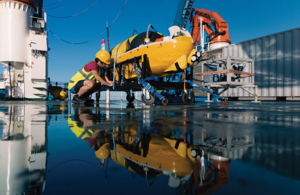
As part of this collaboration, ARDITI acquired 2 Autosub Long Range (ALR) autonomous underwater vehicles developed by NOC, valued at €4.3 million. The agreement supports the deployment of advanced UK marine robotics in the deep waters around Madeira, an area well suited to ultra‑deep‑sea research, while establishing a strategic partnership for future joint scientific activity.
UK capability and collaboration in ocean science
Autosub Long Range vehicles are designed for long‑duration missions and can be fitted with modular sensors to collect data throughout the water column and across the seabed. One vehicle is rated to depths of 1,500 metres and will support oceanographic and biogeochemical research. The second is rated to 6,000 metres and will be used for deep‑sea mapping. The vehicles use an open‑source operating system and are compatible with existing marine platforms. This allows ARDITI to integrate them quickly into its research programmes, alongside uncrewed surface vessels, and conventional research ships. Operations will be managed through the Ocean Observatory of Madeira (OOM), helping to position Madeira as an international hub for deep‑sea testing and research.
The British Embassy marked the partnership with an event aboard the Royal Research Ship Discovery in Madeira on 24 October. The event showcased UK scientific capability to the Madeiran regional government, academic partners, and the local British community.
This followed a marine research roundtable held in Lisbon in February 2025 during Discovery’s port call, which brought together UK and Portuguese researchers ahead of the UN Ocean Conference. Building on this momentum, the British Embassy plans to convene an Ocean Monitoring Workshop in early 2026 to identify further opportunities for joint research and innovation between the UK and Portugal.
The impact
This collaboration grew from sustained UK-Portugal engagement that began in 2019 and demonstrates how science diplomacy can deliver practical outcomes for both countries. For NOC, this was the first sale of ALR technology to a public research agency rather than through a commercial contract, creating a new model for future international partnerships and exports of UK marine technology.
The agreement includes safeguards that restrict onward collaboration with states deemed to pose security risks, ensuring that UK interests and research integrity are protected. Supported by the Natural Environment Research Council, part of UK Research and Innovation, the partnership expands the global reach of UK‑developed technology while strengthening ARDITI’s in‑house robotics capability.
Through shared missions, technical exchange and joint planning, both partners benefit from improved access to high‑quality marine data. This supports regional ocean governance, contributes to global understanding of deep‑sea environments, and reinforces the UK’s reputation as a trusted leader in autonomous marine systems.
https://www.gov.uk/government/news/uk-portugal-partnership-boosts-use-of-robotics-in-marine-research